Don’t Leave Base Units on the Table
One of the most common opportunities I encounter during anesthesia coding audits is the undercoding of ASA 00670. Too often, coders default to ASA 00630 for spinal procedures without taking a closer look at the operative report. While 00630 is appropriate for many lumbar spine surgeries, it is not always the correct choice—especially when spinal instrumentation or extensive spinal reconstruction is involved.
A few extra minutes reviewing the operative report can make the difference between selecting the correct anesthesia code and leaving appropriate reimbursement on the table.
Understanding the Difference
ASA 00630
Anesthesia for procedures in the lumbar region; not otherwise specified
Typically reported for:
- Lumbar laminectomy
- Lumbar discectomy
- Simple decompression procedures
- Procedures without extensive instrumentation
ASA 00670
Anesthesia for extensive spine and spinal cord procedures (e.g., instrumentation or vascular procedures)
Frequently appropriate for:
- Posterior spinal fusion
- Transforaminal Lumbar Interbody Fusion (TLIF)
- Posterior Lumbar Interbody Fusion (PLIF)
- Anterior Lumbar Interbody Fusion (ALIF)
- Multi-level spinal fusion
- Pedicle screw fixation
- Placement of rods, cages, or plates
- Extensive spinal reconstruction
The RVG Comment Many Coders Miss
One of the most important pieces of guidance for ASA 00670 is found in the ASA Relative Value Guide (RVG).
RVG Comment:
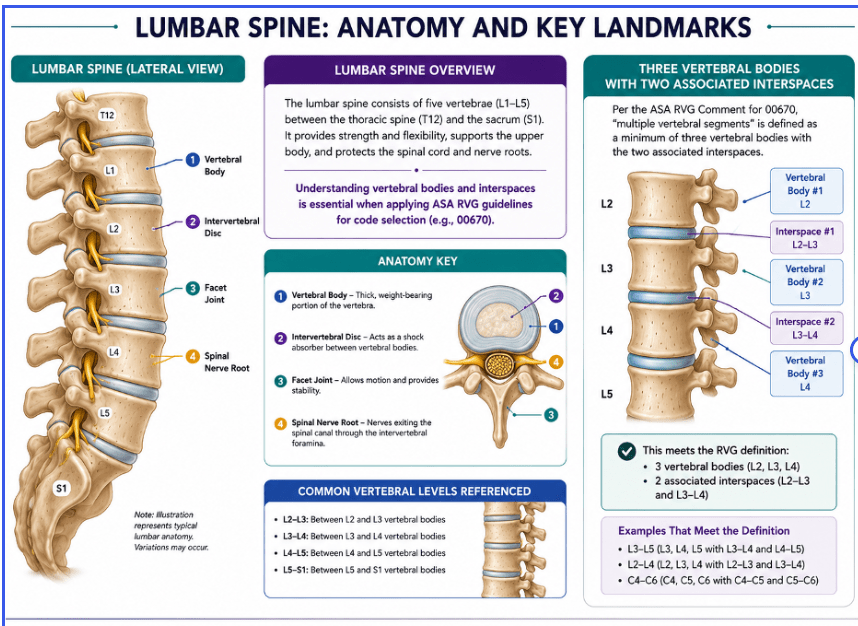
Code 00670 is appropriate only if the surgical procedure includes segmental or non-segmental instrumentation as defined in CPT® or if the procedure includes multiple vertebral segments (minimum three vertebral bodies with the two associated interspaces).
This comment is critical because not every spinal fusion qualifies for 00670. Simply performing a lumbar fusion does not automatically support reporting ASA 00670.
Instead, the operative report must document one of the following:
Option 1
Segmental or non-segmental spinal instrumentation as defined by CPT®, such as:
- Pedicle screw systems
- Rod fixation
- Plates
- Hooks
- Interbody cages when part of instrumented fusion
- Other internal fixation devices used to stabilize the spine
OR
Option 2
The procedure involves multiple vertebral segments, defined in the RVG as:
A minimum of three vertebral bodies with the two associated interspaces.
What Does “Three Vertebral Bodies with Two Associated Interspaces” Mean?
Why Is 00670 Commonly Undercoded?
Many anesthesia coders develop the habit of assigning 00630 whenever they see a lumbar spine procedure. Unfortunately, the operative report often contains additional details that support 00670, but those details may be overlooked.
Common reasons include:
- Reviewing only the procedure title
- Not reading the body of the operative report
- Missing documentation of spinal instrumentation
- Assuming every lumbar fusion uses the same anesthesia code
- Relying solely on the surgical CPT code without analyzing the operative details
- Not being familiar with the RVG comment for ASA 00670
Documentation Clues to Look For
When reviewing the operative report, watch for terms such as:
✔ Pedicle screw instrumentation
✔ Segmental instrumentation
✔ Non-segmental instrumentation
✔ Rod fixation
✔ Interbody cage placement
✔ Posterior spinal fusion
✔ Anterior spinal fusion
✔ Multi-level fusion
✔ Spinal reconstruction
✔ Three or more vertebral bodies involved
These findings should prompt you to evaluate whether ASA 00670 is appropriate.
Coding Example
Clinical Scenario
Procedure Performed
- L4-L5 Transforaminal Lumbar Interbody Fusion (TLIF)
- Posterior spinal fusion
- Pedicle screw instrumentation
- Interbody cage placement
- Fluoroscopic guidance
Incorrect Coding
ASA 00630
The coder selected 00630 simply because the procedure involved the lumbar spine.
Correct Coding
ASA 00670
The operative report documents spinal instrumentation, making 00670 the more appropriate anesthesia code based on the RVG guidance.
Auditor’s Tip
Never determine the anesthesia code from the procedure title alone.
Instead, ask yourself:
- Was instrumentation placed?
- Was the instrumentation segmental or non-segmental?
- Were pedicle screws, rods, cages, or plates implanted?
- Does the procedure involve at least three vertebral bodies with two associated interspaces?
- Does the operative report describe spinal reconstruction rather than simple decompression?
If the answer to any of these questions is yes, pause before assigning 00630 and evaluate whether 00670 is supported by the documentation and RVG guidance.
Documentation Matters
Accurate anesthesia coding depends on understanding what actually occurred during the procedure—not simply matching the surgical CPT code to the first anesthesia code that appears in a crosswalk.
Developing the habit of reviewing the entire operative report helps ensure:
- Accurate reimbursement
- Consistent coding
- Reduced audit risk
- Stronger compliance
- Appropriate application of RVG guidance
Final Thoughts
ASA 00670 is one of the most frequently undercoded anesthesia codes because the documentation supporting it is often found within the details of the operative report—not the procedure title.
Just as importantly, coders should remember that 00670 is not automatically assigned for every spinal fusion. The ASA Relative Value Guide clearly limits its use to procedures that include segmental or non-segmental instrumentation or multiple vertebral segments involving a minimum of three vertebral bodies with two associated interspaces.
Understanding and applying this RVG guidance can improve coding accuracy, reduce audit risk, and help ensure your organization reports the most appropriate anesthesia code.
Have you encountered cases where 00670 was missed—or perhaps reported when the RVG criteria were not met? Share your experiences or questions in the comments. I’d love to continue the conversation.

Leave a comment