• Chapter 4 – Endocrine, Nutritional & Metabolic Diseases

    23 New Codes

    Hyperoxaluria

    E11.A Type 2 diabetes mellitus w/out complications in remission

    E72.53 Primary hyperoxaluria

    • E78.530 Primary hyperoxaluria, type 1
    • E72.538 Other specified primary hyperoxaluria
    • E72.539 Primary hyperoxaluria, unspecified
    • E72.540 Dietary hyperoxaluria
    • E72.541 Enteric hyperoxaluria
    • E72.548 Other secondary hyperoxaluria
    • E72.549 Secondary hyperoxaluria, unspecified

    Hypercholesterolemia

    • E78.01 Familial hypercholesterolemia
    • E78.010 Homozygous familial hypercholesterolemia [HoFH]
    • E78.011 Heterozygous familial hypercholesterolemia [HeFH]
    • E78.019 Familial hypercholesterolemia, unspecified

    Deficiency

    • E83.820 Generalized arterial calcification of infancy with unspecified genetic causality
    • E83.821 ENPP1 deficiency causing generalized arterial calcification of infancy
    • E83.822 ENPP1 deficiency causing autosomal recessive hypophosphatemic rickets type 2
    • E83.823 ABCC6 deficiency causing generalized arterial calcification of infancy
    • E83.824 ABCC6 deficiency causing pseudoxanthomas elasticum
    • E83.825   CD73 deficiency causing arterial calcification

    Code also – need additional codes if applicable

    Lipodystrophy

    E88.1 Lipodystrophy, not elsewhere classified

    • E88.10 Lipodystrophy, unspecified
    • E88.11 Partial lipodystrophy
    • E88.12 Generalized lipodystrophy
    • E88.13 Localized lipodystrophy
    • E88.14 HIV-associate lipodystrophy
    • E88.19 Other lipodystrophy not elsewhere classified
    Disclaimer:
    Chart Talk: Anesthesia Coding Conversations is intended for educational and informational purposes only. The content shared does not constitute legal, billing, compliance, or reimbursement advice. Coding, billing, and reimbursement decisions should be based on official sources such as CPT®, ICD-10-CM, ASA guidelines, payer policies, and individual facility policies, as well as the specific documentation in the medical record. Users are encouraged to consult authoritative resources and/or their compliance department for guidance applicable to their organization.
  • Chapter 1:  Infection and Parasitic Disease

    B88.0 Other acariasis

    • B88.01 Infestation by Demodex mites
    • B88.09 Other acariasis

    Chapter 2:  Neoplasm

    • C50.A0 Malignant inflammatory neoplasm of unspecified breast
    • C50.A1 Malignant inflammatory neoplasm of right breast
    • C50.A2 Malignant inflammatory neoplasm of left breast

    Chapter 3:  Diseases of the Blood and Blood-Forming Organs and Certain Disorders Involving the Immune Mechanism

    D71 Functional disorders of polymorphonuclear neutrophils 

    • D71.1 Leukocyte adhesions deficiency
    • D71.8 Other functional disorders of polymorphonuclear neutrophils
    • D71.9 Functional disorders of polymorphonuclear neutrophils, unspecified
    Version 1.0.0

    Disclaimer:
    Chart Talk: Anesthesia Coding Conversations is intended for educational and informational purposes only. The content shared does not constitute legal, billing, compliance, or reimbursement advice. Coding, billing, and reimbursement decisions should be based on official sources such as CPT®, ICD-10-CM, ASA guidelines, payer policies, and individual facility policies, as well as the specific documentation in the medical record. Users are encouraged to consult authoritative resources and/or their compliance department for guidance applicable to their organization.

  • “If you ask for someone’s insight but only accept your own answer, you don’t want collaboration—you want confirmation.”

  • When we help others succeed, it doesn’t take away from our own accomplishments—it actually strengthens them. There is no shortage of success in this world; lifting someone else up doesn’t make you smaller, it makes the entire space brighter. Too often we fall into the mindset that someone else’s win somehow subtracts from ours, but in reality, collaboration, support, and generosity expand opportunity for everyone. Your knowledge, your experience, and your kindness are not diminished by sharing them—they grow. When you choose to help someone else rise, you’re not dimming your light; you’re proving just how strong it really is.

  • Just an FYI! I have edited the Post Op Pain articles and included at the bottom, under the anatomical picture a link where you can download the file.

    Going forward the monthly newsletter will also be added as a download. I did this for the November issue and really liked it so I went back today and created the October edition the same way.

    Anything that you would like to see as a downloadable please reach out and share.

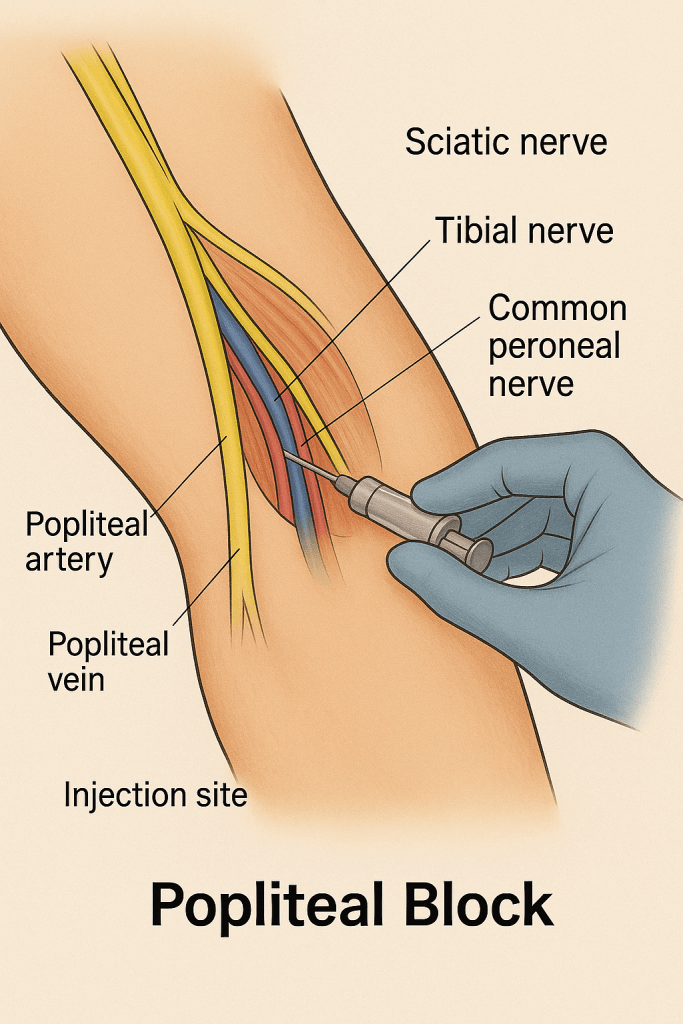
  • In the world of anesthesia, precision and patient-centered care go hand in hand — and the popliteal nerve block is a perfect example of both. This regional anesthesia technique provides targeted pain relief for procedures involving the lower leg, ankle, and foot, often minimizing the need for systemic opioids and enhancing postoperative comfort.

    Clinical Overview

    The popliteal nerve block targets the sciatic nerve in the popliteal fossa, just proximal to its bifurcation into the tibial and common peroneal nerves.

    Common indications include:

    • Achilles tendon repair

    • Bunionectomy

    • Foot and ankle surgery

    • Calf or lower leg soft tissue procedures

    Performed with ultrasound or nerve stimulator guidance, this block delivers effective analgesia and anesthesia to the distal lower extremity — while preserving quadriceps strength, allowing for earlier mobilization.

    Coding and Documentation Insight

    Proper coding ensures compliance and accurate reimbursement. The CPT® code 64445 represents:

    Injection, anesthetic agent; sciatic nerve, single

    If the block is performed postoperatively for pain control, and not as the primary anesthetic, it is reported separately from the anesthesia service.

    Coding tips:

    • Append modifier -59 when the block is distinct from the intra-operative anesthesia service.

    • Always link to a postoperative pain diagnosis such as G89.18 (Other acute postoperative pain).

    Documentation should include:

    • Anatomical site and laterality

    • Indication (postoperative pain vs surgical anesthesia)

    • Technique (ultrasound-guided, nerve stimulator)

    • Local anesthetic and volume used

    • Evidence of patient tolerance and effectiveness

    Make sure that MAC is not the anesthesia technique. If so, then the Popliteal is part of the anesthetic and not allowed to be billed a post op pain block.

    Ensure that you understand the difference between the Popliteal and Saphenous (64450) as well as Saphenous (64447)

    Disclaimer:
    Chart Talk: Anesthesia Coding Conversations is intended for educational and informational purposes only. The content shared does not constitute legal, billing, compliance, or reimbursement advice. Coding, billing, and reimbursement decisions should be based on official sources such as CPT®, ICD-10-CM, ASA guidelines, payer policies, and individual facility policies, as well as the specific documentation in the medical record. Users are encouraged to consult authoritative resources and/or their compliance department for guidance applicable to their organization.

  • Creating meaningful change in a position isn’t always about having the highest title or the most authority—it’s about having vision, initiative, and the willingness to take action. Whether you’re part of a large organization or a small team, you can influence positive transformation from exactly where you stand. Change often begins with one person who decides to approach challenges differently, communicate openly, and inspire others by example.

    1. See the Need Before It’s Assigned

    Some of the most impactful changes start when someone identifies a gap before it becomes a problem. Pay attention to patterns, recurring questions, or outdated processes. When you can anticipate needs and offer solutions proactively, you not only create value—you build trust.

    2. Share Your Expertise Generously

    When you share what you know, you raise the collective knowledge of your team. This can be as simple as creating a quick reference tool, offering to train someone, giving feedback, or building out educational content. Teaching others positions you as a resource and naturally shifts the team culture toward growth.

    3. Communicate With Purpose

    Change requires clear communication. Whether you’re proposing a new workflow, offering feedback, or identifying risks, communicate openly and respectfully. Explain the “why,” not just the “what.” When people understand the purpose behind a change, they’re more willing to support it.

    4. Take Initiative Without Waiting for Permission

    Transformation often begins with someone saying, “I’ll take the lead.” Don’t wait for a formal assignment to start working on something you know will improve outcomes. Creating a template, drafting a process, proposing a new idea, or even simply volunteering can shift momentum quickly.

    5. Build Relationships and Collaborate

    Change is rarely accomplished alone. Partner with peers, leadership, and cross-functional teams to build alignment. Collaboration helps strengthen your ideas, gain buy-in, and ensure long-term success. When people feel involved, they feel invested.

    6. Embrace Continuous Improvement

    True change isn’t a one-time action—it’s an ongoing mindset. Keep educating yourself, ask questions, seek feedback, and remain open to refining your work. Growth requires adaptability, and leaders who embrace learning ultimately become catalysts for organizational transformation.

    7. Influence Through Consistency

    People follow what they see, not just what they hear. When your actions consistently reflect high standards, integrity, and professionalism, you naturally influence others. Consistency builds credibility, and credibility fuels change.

    8. Celebrate Wins—Big and Small

    Recognizing progress motivates others and reinforces why the change matters. Celebrate improvements, thank team members, and highlight achievements. Positivity creates momentum.

    Final Thoughts

    Creating change in a position isn’t about waiting for authority—it’s about stepping into influence. It’s about being intentional, proactive, and committed to making things better for your team, your organization, and the people you serve.

    When you lead with purpose, share knowledge freely, and take initiative, you don’t just contribute—you elevate. And sometimes, that’s exactly what inspires others to do the same.

  • Disclaimer:
    Chart Talk: Anesthesia Coding Conversations is intended for educational and informational purposes only. The content shared does not constitute legal, billing, compliance, or reimbursement advice. Coding, billing, and reimbursement decisions should be based on official sources such as CPT®, ICD-10-CM, ASA guidelines, payer policies, and individual facility policies, as well as the specific documentation in the medical record. Users are encouraged to consult authoritative resources and/or their compliance department for guidance applicable to their organization.
  • Post-operative nerve blocks are a valuable component of anesthesia care — enhancing patient comfort, reducing opioid use, and supporting faster recovery. But from a coding and billing standpoint, clarity is key.

    CPT 64447 = Injection, anesthetic agent; femoral nerve, single

    This code is commonly used when documenting post-operative analgesia for knee and lower-extremity procedures. However, the challenge often lies in how these blocks are documented and referenced in the anesthesia record or operative note.

    • You might see it referred to as:
    • Femoral nerve block
    • Adductor canal block
    • Saphenous nerve block

    Key Reminders:

    • Ensure documentation supports the nerve targeted and that it was performed separately from the surgical anesthesia.

    • Append modifier -59 when the block is distinct from the intra-operative anesthesia service.

    When properly documented, these blocks not only improve patient care — they reflect the full scope of anesthesia services provided.

    Question for my anesthesia coders and providers:

    What’s your most common documentation challenge when reporting post-operative blocks?

    #AnesthesiaCoding #MedicalCoding #AnesthesiaBilling #RegionalAnesthesia #PostOpPainManagement #Compliance #RevenueIntegrity

    Disclaimer:
    Chart Talk: Anesthesia Coding Conversations is intended for educational and informational purposes only. The content shared does not constitute legal, billing, compliance, or reimbursement advice. Coding, billing, and reimbursement decisions should be based on official sources such as CPT®, ICD-10-CM, ASA guidelines, payer policies, and individual facility policies, as well as the specific documentation in the medical record. Users are encouraged to consult authoritative resources and/or their compliance department for guidance applicable to their organization.

  • Mark your calendar and make plans to join the Durham NC AAPC Chapter on February 21, 2026 from 10-11:30 as I present Anesthesia 101 – Introduction to Anesthesia Coding for 1.5 CEUs. As soon as the registration form becomes available I will make sure that I share the information here on the blog..