• Another week, another opportunity to learn something new in anesthesia pain management. This week’s spotlight focuses on an unusual but increasingly common technique used for post-operative pain control: fascial plane blocks—with a special focus on the Erector Spinae Plane (ESP) block.

    What Is a Fascial Plane Block?

    Fascial plane blocks are regional anesthesia techniques where local anesthetic is injected between layers of fascia, rather than directly targeting a single named nerve. The medication spreads along the fascial plane, allowing coverage of multiple nerve branches and dermatomes.

    Why the ESP Block Is Considered Unusual

    The Erector Spinae Plane (ESP) block is considered unusual because it is performed at a location distant from the spinal cord and major nerve roots, yet it provides broad thoracic or lumbar analgesia. The block is placed deep to the erector spinae muscle, allowing cranio-caudal spread of anesthetic.

    Common uses include:

    • – Thoracic surgery
    • – Rib fractures
    • – Breast surgery
    • – Abdominal and colorectal procedures
    • – Spine surgery

    Fascial Plane Block CPT Codes

    Fascial plane blocks, including ESP blocks, are reported using the following CPT codes:

    Thoracic (ESP) Fascial Plane Block Codes

    CPT 64466 – Single injection, (unilateral)

    CPT 64467 – Continuous catheter (unilateral)

    CPT 64468 – Single injection, (bilateral)

    CPT 64469 – Continuous catheter (bilateral)

    Lumbar & Sacral (ESP) Fascial Plane Block Code

    CPT 64999 – Unlisted Procedure

    Documentation Requirements

    To support billing for fascial plane blocks, documentation should clearly include:

    • – Indication for post-operative pain control
    • – Anatomical level(s): thoracic or lumbar
    • – Single-shot versus continuous catheter technique
    • – Laterality when applicable
    • – Separate documentation from the surgical anesthesia record
    • – Timing of the block (pre-op, intra-op for post-op pain, or post-op)

    Common Audit Pitfalls

    A frequent audit issue occurs when documentation simply states ‘ESP block performed’ without specifying the level, technique, or indication for post-operative pain. Incomplete documentation may result in denials or downcoding.

    Closing Thoughts

    Fascial plane blocks like the ESP block highlight how anesthesia pain management continues to evolve. For coders and auditors, understanding both the clinical intent and the CPT coding requirements is essential to ensure accurate reporting and compliance.

    DISCLAIMER:  Chart Talk:  Anesthesia Coding Conversations is intended for educational and informational purposes only. The information presented reflects the sole interpretation and professional opinion of the presenter. It does not represent the views or official guidance of my employer, the Centers for Medicare & Medicaid Services (CMS), the American Medical Association (AMA), or any other regulatory or governing body.

    Every reasonable effort has been made to ensure the accuracy of the information provided at the time of publication. However, coding guidelines, regulations, and payer policies are subject to change. It is the responsibility of the reader or participant to verify current guidance and apply professional judgment when making coding and billing decisions.

    — Dianne
    Chart Talk: Anesthesia Coding Conversations

  • DISCLAIMER:  Chart Talk:  Anesthesia Coding Conversations is intended for educational and informational purposes only. The information presented reflects the sole interpretation and professional opinion of the presenter. It does not represent the views or official guidance of my employer, the Centers for Medicare & Medicaid Services (CMS), the American Medical Association (AMA), or any other regulatory or governing body.

    Every reasonable effort has been made to ensure the accuracy of the information provided at the time of publication. However, coding guidelines, regulations, and payer policies are subject to change. It is the responsibility of the reader or participant to verify current guidance and apply professional judgment when making coding and billing decisions.

    — Dianne
    Chart Talk: Anesthesia Coding Conversations

  • Hypothermic circulatory arrest (HCA) is one of the most complex and high-risk techniques used in cardiac and major vascular surgery. Because of its complexity—and its frequent confusion with hypothermia alone—it is also an area where anesthesia coding errors commonly occur.
    This post breaks down what HCA ishow it differs from hypothermia without arrest, and when ASA code 00563 is appropriate.


    What Is Hypothermic Circulatory Arrest?

    Hypothermic circulatory arrest is a planned, intentional cessation of systemic blood circulation, achieved after cooling the patient to a deep hypothermic state (typically ≤20°C / 68°F).

    Key elements of HCA:

    • Complete stoppage of circulation
    • Deep hypothermia induced via cardiopulmonary bypass
    • Neuroprotection achieved by reducing cerebral metabolic demand
    • Time-limited arrest period, followed by controlled reperfusion and rewarming

    This technique is most often used when bloodless surgical fields are required—such as in complex aortic arch repairs—where clamping alone is not sufficient.


    Hypothermia vs. Hypothermic Circulatory Arrest

    (Why this distinction matters for coding)

    Hypothermia OnlyHypothermic Circulatory Arrest
    Cooling used as a protective measureCooling plus total circulatory arrest
    Circulation continuesCirculation is completely stopped
    Common during routine cardiac bypassUsed only in select high-risk cases
    Not separately reportableSeparately reportable with ASA 00563

    Important: Hypothermia alone—even deep hypothermia—does not qualify for ASA 00563 unless circulatory arrest is clearly documented.


    What Is ASA 00563?

    ASA 00563 represents anesthesia services involving hypothermic circulatory arrest.
    It is not an add-on for hypothermia, and it should not be reported unless the case meets strict clinical and documentation criteria.

    Typical procedures where HCA may apply:

    • Aortic arch reconstruction or replacement
    • Complex thoracic aortic aneurysm repair
    • Certain congenital cardiac surgeries requiring bloodless fields

    Documentation Requirements to Support ASA 00563

    Clear, explicit documentation is critical. The anesthesia record should support all of the following:

    1. Intentional Circulatory Arrest

    • Explicit wording such as:
      • “Circulatory arrest initiated”
      • “Systemic circulation stopped”
    • Vague statements like “deep hypothermia achieved” are not sufficient

    2. Arrest Start and Stop Times

    • Precise start and end times of circulatory arrest
    • Duration documented in minutes

    3. Core Temperature

    • Documentation of deep hypothermia (often ≤20°C)
    • Recorded via reliable monitoring (e.g., nasopharyngeal, bladder, or esophageal probe)

    4. Reperfusion and Rewarming

    • Documentation that circulation was restarted
    • Controlled rewarming process noted

    Common Coding Pitfalls

    🚫 Do not report ASA 00563 when:

    • Hypothermia is used without stopping circulation
    • Only cardiopulmonary bypass is documented
    • Arrest time is implied but not clearly stated
    • Surgeon documentation is vague and anesthesia record lacks confirmation

    ✅ Do report ASA 00563 when:

    • Circulatory arrest is clearly intentional and documented
    • Arrest duration is specified
    • Deep hypothermia is confirmed
    • The anesthesia record independently supports the service

    Audit Tip: Defending ASA 00563

    When preparing for an audit:

    • Ensure anesthesia documentation stands alone
    • Do not rely solely on operative reports
    • Verify arrest times match perfusion and anesthesia records
    • Use consistent terminology across the case record

    A simple checklist approach can dramatically reduce denials and post-payment recoupments for this high-risk code.


    Final Takeaway

    ASA 00563 is reserved for true hypothermic circulatory arrest—not hypothermia alone.
    The distinction hinges on complete cessation of circulation, supported by clear, time-based anesthesia documentation.

    Accurate coding protects both compliance and reimbursement—and ensures that the complexity of these high-risk anesthesia services is properly recognized.


    DISCLAIMER:  Chart Talk:  Anesthesia Coding Conversations is intended for educational and informational purposes only. The information presented reflects the sole interpretation and professional opinion of the presenter. It does not represent the views or official guidance of my employer, the Centers for Medicare & Medicaid Services (CMS), the American Medical Association (AMA), or any other regulatory or governing body.

    Every reasonable effort has been made to ensure the accuracy of the information provided at the time of publication. However, coding guidelines, regulations, and payer policies are subject to change. It is the responsibility of the reader or participant to verify current guidance and apply professional judgment when making coding and billing decisions.

    — Dianne
    Chart Talk: Anesthesia Coding Conversations

  • Brachial Plexus – CPT 64415/64416

    A brachial plexus nerve block is a regional anesthesia technique where local anesthetic is injected near the brachial plexus (a network of nerves for the arm) in the neck, above the collarbone, or armpit to numb the entire arm for surgery or to manage chronic pain, often as alternative to general.  When brachial plexus is used for acute post op pain management 

    How does it work and its purpose?

    • Blocks Pain:  Temporarily stops pain and movement in the arm by numbing the nerve bundle.
    • Surgical Anesthesia:  Allows for awake or sedated surgery on the arm shoulder, or hand, avoiding general anesthesia side effects.
    • Pain Management:  Provides relief for arm and shoulder pain.

    Common Approaches:

    • Interscalene:  Near the neck (between scalene muscles), best for shoulder surgery.
    • Supraclavicular:  Above the collarbone, excellent for elbow, wrist, and hand surgery.
    • Infraclavicular:  Below the collarbone
    • Axillary:  In the armpit, for hand, wrist, and forearm procedures.  

    Procedure & Guidance:

    A doctor uses landmarks and often ultrasound to guide a needle to inject anesthetic near the nerves, sometimes placing a catheter for continuous pain relief.  Ultrasound is bundled with code 64415/64416.

    Axillary Nerve Block – CPT 64417

    An ancillary nerve block is used for post op pain control, often for surgeries in the forearm, hand, wrist, or shoulder.  It is billed for a single injection, providing pain relief by temporarily interrupting nerve signals, and requires specific documentation showing it’s separate from the main surgical anesthetic for. Post-op pain management.

    How it Works for Post-Op Pain:

    • The axillary nerve block targets the axillary nerve, a key nerve from the brachial plexus, located near the armpit.
    • Anesthetic is injected near the nerve, often within a fascial compartment, to numb the area and block pain signals.
    • It’s a common component of multimodal pain strategies to reduce reliance on opioids.

    Common Usage Examples:

    • Pain control after wrist fractures, elbow surgeries or shoulder surgeries.
    • Part of a comprehensive approach (along with other blocks like the suprascapular nerve block) for shoulder analgesia.

    * Axillary approach to Brachial Plexus is coded as 64415 (typically shoulder cases).  True Axillary Blocks target the Axillary nerve and are coded 64417 (typically forearm/wrist/hand procedures).  Review the block note to confirm the targeted nerve

    Suprascapular Nerve Block – CPT 64418

    A suprascapular nerve block (SSNB) is a highly effective technique for managing acute postoperative shoulder pain, especially after arthroscopic procedures, by injecting local anesthetic around the nerve that supplies about 70% of the shoulder’s sensation, significantly reducing opioid needs, nausea, and pain scores, and allowing for earlier rehabilitation. It’s a safe alternative for patients with lung issues who can’t have general nerve blocks and can be combined with other blocks (like axillary) for even better results, though it’s less effective than a full interscalene block but offers better safety. 

    How It Works:

    • Injection: A doctor injects a local anesthetic (like lidocaine/bupivacaine) near the suprascapular nerve, often guided by ultrasound for precision.
    • Pain Interruption: The anesthetic temporarily blocks pain signals from the shoulder joint to the brain.
    • Safer Alternative: Avoids phrenic nerve block (diaphragm paralysis) seen with interscalene blocks, making it ideal for patients with lung disease, notes ASRA Pain Medicine.

    When It’s Used:

    • Arthroscopic shoulder surgeries (rotator cuff repair, etc.).
    • Chronic shoulder pain (arthritis, frozen shoulder, tendonitis). 

    Techniques:

    • Posterior Approach: Common, targeting the nerve at the suprascapular notch.
    • Anterior Approach: Also described and effective.
    • Combination: Often paired with an axillary nerve block (SSNB+ANB) for comprehensive pain relief, though it may not surpass a standard interscalene block (ISB) but offers fewer side effects like breathing issues. 

    Suprascapular Nerve Block – CPT 64418

    A suprascapular nerve block (SSNB) is a highly effective technique for managing acute postoperative shoulder pain, especially after arthroscopic procedures, by injecting local anesthetic around the nerve that supplies about 70% of the shoulder’s sensation, significantly reducing opioid needs, nausea, and pain scores, and allowing for earlier rehabilitation. It’s a safe alternative for patients with lung issues who can’t have general nerve blocks and can be combined with other blocks (like axillary) for even better results, though it’s less effective than a full interscalene block but offers better safety. 

    How It Works:

    • Injection: A doctor injects a local anesthetic (like lidocaine/bupivacaine) near the suprascapular nerve, often guided by ultrasound for precision.
    • Pain Interruption: The anesthetic temporarily blocks pain signals from the shoulder joint to the brain.
    • Safer Alternative: Avoids phrenic nerve block (diaphragm paralysis) seen with interscalene blocks, making it ideal for patients with lung disease, notes ASRA Pain Medicine.

    When It’s Used:

    • Arthroscopic shoulder surgeries (rotator cuff repair, etc.).
    • Chronic shoulder pain (arthritis, frozen shoulder, tendonitis). 

    Techniques:

    • Posterior Approach: Common, targeting the nerve at the suprascapular notch.
    • Anterior Approach: Also described and effective.
    • Combination: Often paired with an axillary nerve block (SSNB+ANB) for comprehensive pain relief, though it may not surpass a standard interscalene block (ISB) but offers fewer side effects like breathing issues. 

    DISCLAIMER:  Chart Talk:  Anesthesia Coding Conversations is intended for educational and informational purposes only. The information presented reflects the sole interpretation and professional opinion of the presenter. It does not represent the views or official guidance of my employer, the Centers for Medicare & Medicaid Services (CMS), the American Medical Association (AMA), or any other regulatory or governing body.

    Every reasonable effort has been made to ensure the accuracy of the information provided at the time of publication. However, coding guidelines, regulations, and payer policies are subject to change. It is the responsibility of the reader or participant to verify current guidance and apply professional judgment when making coding and billing decisions.

    — Dianne
    Chart Talk: Anesthesia Coding Conversations

  • Post-operative pain blocks continue to be an area of confusion for many coders, auditors, and providers—particularly when it comes to what is separately reportable, which CPT codes apply, and what documentation is truly required to support billing. This multi-part series is designed to break post-op pain block coding down into clear, practical segments, beginning with a foundational overview of the applicable CPT codes and the documentation elements that must be present to support compliant billing. Each installment will build on the last, addressing common scenarios, compliance pitfalls, and audit-focused considerations to help ensure post-operative pain management services are coded accurately, defensibly, and consistently.

    What is required in the documentation in order for the post op block to be billable?

    1. Who placed the block? We as coders and auditors cannot assume that the attending Anesthesiologist/CRNA for the anesthesia sedation service also performed the block. The block note documentation must clearly identify the specific provider or who placed the block.  
    2. Who requested the block? The documentation for the block should clearly indicate that it was placed at the surgeon’s request. Phrases such as “per surgeon’s request” or “for post-operative pain management, at the request of the surgeon” are commonly used and help establish this. This language is important to support medical necessity in the event of payer questions or audits. Ultimately, the surgeon is responsible for post-operative pain management and must delegate that responsibility when appropriate. 
    3. What type of block? Coders and auditors should identify the block type by looking for the specific name of the block performed — for example, interscalene, adductor canal, femoral, intercostal, etc. 
    4. What delivery method was used to administer the post-operative pain procedure? The documentation must clearly indicate whether it was a single-shot injection or a continuous catheter technique. CPT selection should be based on the documented method of delivery. 
    5. Where was the block placed? Accurate code selection depends on the anatomical location documented in the documentation Specifically, the documentation should clearly identify the nerve or region that was injected, infused, or blocked. For example, a block labeled as “Saphenous” may be reported using CPT 64447 (Femoral nerve block) if performed in the mid-thigh region (Adductor Canal), or CPT 64450 (Other peripheral nerve or branch) if performed below the knee. Additionally, the documentation must specify laterality—whether the block was performed on the left, right, or both sides—to ensure correct coding. 
    6. Why was the block placed? Anesthesiologists must clearly document the indication for the block. When a block is performed specifically for post-operative pain and is separately billable as a fee for service, it requires distinct documentation that supports its medical necessity as a separate service. If the documentation is unclear or leaves room for interpretation regarding whether the block was part of the primary anesthetic, coders should query the clinician for clarification to ensure accurate coding and compliance. 
    7. When was the block placed? The AMA (American Medical Association) has clarified that anesthesia time can be billed for the period spent placing a block, provided the block placement occurs after induction of the primary anesthetic but before emergence. If the block is placed after anesthesia start time but before induction, discontinuous anesthesia time should be applied, meaning the time spent performing the block is excluded from the total billable anesthesia time. To accurately determine if block time is billable or if discontinuous time must be applied, coder should review the following key documentation elements:   Start time of the block injection/placement of catheter   * Stop time of the block injection/catheter   Induction time (primary anesthetic)  
    8. Was the block performed under ultrasound guidance? In 2025, most block codes now include ultrasound guidance, but there are some (64450) that still don’t so it is important to know what type of verbiage we need in order to bill 76942. Ultrasound guidance may be separately billable when it is not included in the description of the nerve block and is adequately supported by documentation. To meet medical necessity requirements, the ultrasound image must be retained in the patient’s permanent medical record and clearly identify the patient and date of service.  The documentation should include language similar to the following examples:  Ultrasound guidance used to guide the needle for satisfactory placement (e.g. “Under US, needle guided and appropriately placed.” “Ultrasound guidance used for needle placement”). Ultrasound guidance used to view medication diffusion (e.g., “US used to visualize spread of anesthetic,” “Medication spread viewed under U/S”). 

    Below is a quick overview of different blocks and there CPT Codes. In the Post-Op Block Series, I will be covering different blocks each week.

    Description2026 Code
    Brachial Plexus64415
    Brachial Plexus 64416
    Axillary Nerve*64417
    Suprascapular Nerve64418
    Intercostal Nerve, Single Level64420
    Intercostal Nerve (each additional level)64421
    Ilioinguinal, iliohypogastric Nerves64425
    Pudendal Nerve64430
    Paracervical (uterine) Nerve64435
    Sciatic Nerve64445
    Sciatic Nerve64446
    Femoral Nerve64447
    Femoral Nerve64448
    Lumbar Plexus; Continuous64449
    Other Peripheral Nerve or Branch64450
    Sacroiliac Joint64451
    Genicular Nerve64454
    Paravertebral block (PVB) (paraspinous block)64461
    Paravertebral block (PVB) (paraspinous block)64462
    Paravertebral block (PVB) (paraspinous block)64463
    Thoracic Fascial Plane Block Codes***64466
    Thoracic Fascial Plane Block Codes64467
    Thoracic Fascial Plane Block Codes64468
    Thoracic Fascial Plane Block Codes64469
    Lower Extremity Fascial Plane Blocks64473
    Lower Extremity Fascial Plane Blocks64474
    Abdominal Fascial Plane Blocks (TAP Blocks)64486
    Abdominal Fascial Plane Blocks (TAP Blocks)64487
    Abdominal Fascial Plane Blocks (TAP Blocks)64888
    Abdominal Fascial Plane Blocks (TAP Blocks)64889
    Unlisted64999
    * Axillary approaoch to Brachial Plexus is coded as 64415 (typically shoulder cases).  True Axillary Blocks target the Axillary nerve and are coded 64417 (typically forearm/wrist/hand procedures).  Review block note to confirm targeted nerve

    Disclaimer:
    Chart Talk: Anesthesia Coding Conversations is intended for educational and informational purposes only. The content shared does not constitute legal, billing, compliance, or reimbursement advice. Coding, billing, and reimbursement decisions should be based on official sources such as CPT®, ICD-10-CM, ASA guidelines, payer policies, and individual facility policies, as well as the specific documentation in the medical record. Users are encouraged to consult authoritative resources and/or their compliance department for guidance applicable to their organization.

  • 1. Base Units

    • Assigned by ASA to each anesthesia CPT code.

    • Represent procedure complexity.

    • Fixed amount—does not change with case duration.

    2. Time Units

    • Begins when anesthesia care starts; ends when no longer personally providing services.

    • Most payers: 1 unit = 15 minutes.

    • Medicare: billed based on actual minutes.

    How to calculate and report anesthesia time properly depends on the payer. For payers that follow CPT® rules, report time per 15 minute intervals. At least half this time (7.5 minutes) must pass to report a unit. For example:

    30 minutes of anesthesia = two units (30=15+15)

    38 minutes of anesthesia = three units (38=15+15+8)

    37 minutes of anesthesia = two units (37=15+15+7)

    Medicare providers follow Centers for Medicare & Medicaid Services guidelines, found in the Internet Only Manual, Claims Processing

    Manual 100-04 Chapter 12:

    G. Anesthesia Time … is defined as the period during which an anesthesia practitioner is present with the patient. It starts when the anesthesia practitioner begins to prepare the patient for anesthesia services in the operating room or an equivalent area and ends when the anesthesia practitioner is no longer furnishing anesthesia services to the patient, that is, when the patient may be placed safely under postoperative care. Anesthesia time is a continuous time period from the start of anesthesia to the end of an anesthesia service. In counting anesthesia time for services furnished on or after January 1, 2000, the anesthesia practitioner can add blocks of time around an interruption in anesthesia time as long as the anesthesia practitioner is furnishing continuous anesthesia care within the time periods around the interruption. Actual anesthesia time in minutes is reported on the claim. For anesthesia services furnished on or after January 1, 1994, the A/B MAC computes time units by dividing reported anesthesia time by 15 minutes. Round the time unit to one decimal place. The A/B MAC does not recognize time units for CPT codes 01995 or 01996. For purposes of this section, anesthesia practitioner means a physician who performs the anesthesia service alone, a CRNA who is not medically directed, or a CRNA or AA, who is medically directed. The physician who medically directs the CRNA or AA would ordinarily report the same time as the CRNA or AA reports for the CRNA service.

    3. Modifying Units

    • Added based on patient risk or circumstances.

    • Physical Status: P3 (+1), P4 (+2), P5 (+3) for commercial payers.

    • Emergency modifier (ET) may increase payment.

    • Medical direction modifiers (AA, QK, QX, QZ) affect payment split.

    4. Anesthesia Billing Formula

    • (Base Units + Time Units + Modifying Units) × Conversion Factor (CF) = Charge

    5. Example

    Procedure: Lap Chole (ASA 00790)

    Base Units: 7

    Time: 90 minutes → 6 units (90 ÷ 15)

    Modifier: P3 (+1 unit)

    CF: $25

    Total Units: 7 + 6 + 1 = 14

    Charge: 14 × $25 = $350

    6. Documentation Essentials

    • Accurate anesthesia start & stop times required.

    • Only one ASA code billed per encounter.

    • Include provider type (MD/CRNA) and applicable modifiers.

    Quick Summary

    Charges depend on:

    • Base Units

    • Time Units

    • Modifying Units

    • Conversion Factor

    Formula: Total Units × CF = Reimbursement

    Disclaimer:
    Chart Talk: Anesthesia Coding Conversations is intended for educational and informational purposes only. The content shared does not constitute legal, billing, compliance, or reimbursement advice. Coding, billing, and reimbursement decisions should be based on official sources such as CPT®, ICD-10-CM, ASA guidelines, payer policies, and individual facility policies, as well as the specific documentation in the medical record. Users are encouraged to consult authoritative resources and/or their compliance department for guidance applicable to their organization.

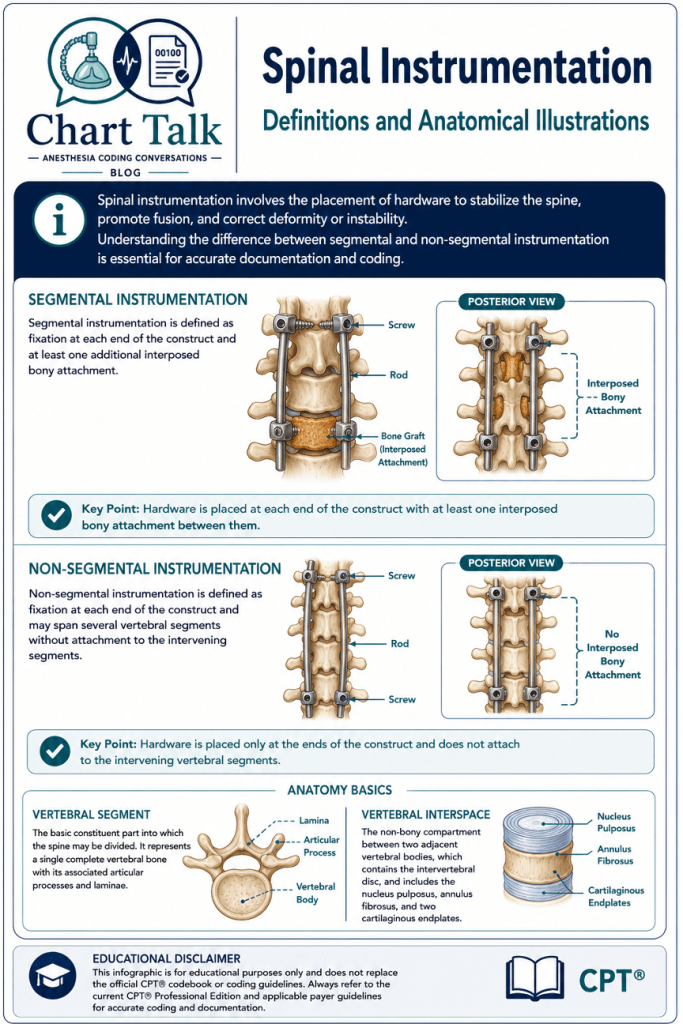
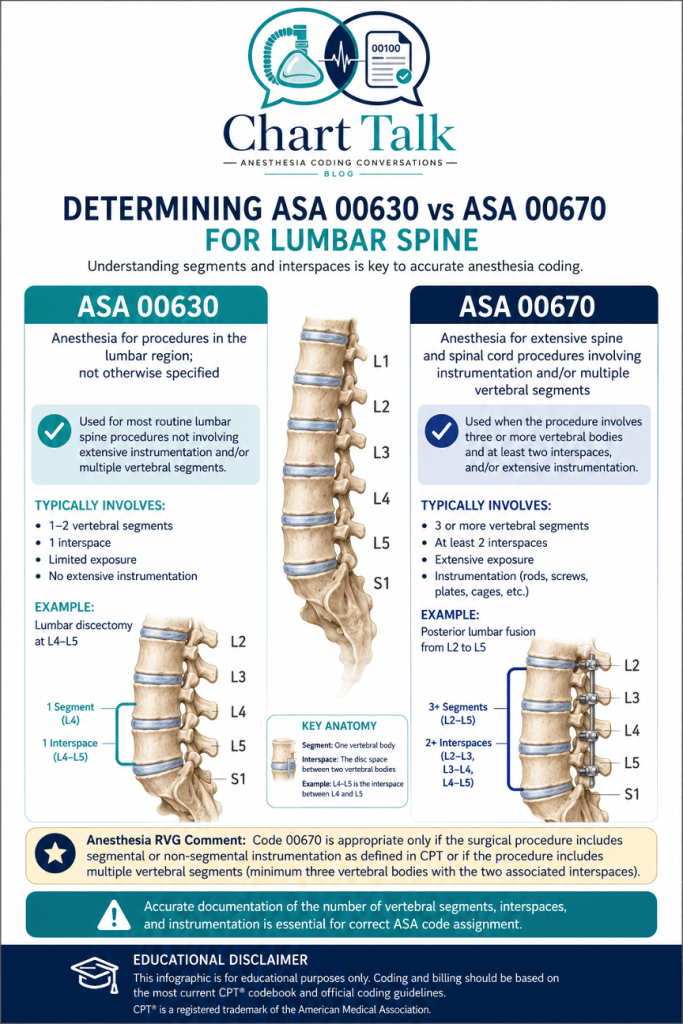
  • In spinal surgery, instrumentation refers to any hardware implanted into the spine to provide stability, correction, or fixation. It is used to immobilize spinal segments, maintain alignment, or support fusion.

    Common Types of Spinal Instrumentation

    1. Pedicle Screws
    • Placed through the pedicle into the vertebral body
    • Provide the primary anchor point
    • Used in almost all thoracolumbar fusions
    2. Rods
    • Long metal rods connecting pedicle screws
    • Allow correction of deformity and stabilization
    3. Plates
    • Anterior cervical plates most common
    • Secured with screws to maintain alignment after fusion
    4. Interbody Devices (Cages)
    • Inserted into the disc space
    • Restore disc height
    • Promote fusion with bone graft
    5. Hooks
    • Used in scoliosis or deformity surgery
    • Anchor at lamina or transverse process
    6. Wires / Cables
    • Sublaminar wires or titanium cables
    • Used when screw purchase is poor
    7. Crosslinks
    • Connect left and right rod to increase torsional stability

    Coding Note (If You Need It for CPT Documentation)

    Instrumentation is coded separately from the fusion procedure, usually using:

    • 22840–22847 for posterior segmental/nonsegmental instrumentation
    • 22853–22859 for interbody devices
    • 22848 for crosslink placement
    • +22899 for unlisted situations

    Disclaimer:
    Chart Talk: Anesthesia Coding Conversations is intended for educational and informational purposes only. The content shared does not constitute legal, billing, compliance, or reimbursement advice. Coding, billing, and reimbursement decisions should be based on official sources such as CPT®, ICD-10-CM, ASA guidelines, payer policies, and individual facility policies, as well as the specific documentation in the medical record. Users are encouraged to consult authoritative resources and/or their compliance department for guidance applicable to their organization.

  • In the world of anesthesia, precision and patient-centered care go hand in hand — and the popliteal nerve block is a perfect example of both. This regional anesthesia technique provides targeted pain relief for procedures involving the lower leg, ankle, and foot, often minimizing the need for systemic opioids and enhancing postoperative comfort.

    Clinical Overview

    The popliteal nerve block targets the sciatic nerve in the popliteal fossa, just proximal to its bifurcation into the tibial and common peroneal nerves.

    Common indications include:

    • Achilles tendon repair

    • Bunionectomy

    • Foot and ankle surgery

    • Calf or lower leg soft tissue procedures

    Performed with ultrasound or nerve stimulator guidance, this block delivers effective analgesia and anesthesia to the distal lower extremity — while preserving quadriceps strength, allowing for earlier mobilization.

    Coding and Documentation Insight

    Proper coding ensures compliance and accurate reimbursement. The CPT® code 64445 represents:

    Injection, anesthetic agent; sciatic nerve, single

    If the block is performed postoperatively for pain control, and not as the primary anesthetic, it is reported separately from the anesthesia service.

    Coding tips:

    • Append modifier -59 when the block is distinct from the intra-operative anesthesia service.

    • Always link to a postoperative pain diagnosis such as G89.18 (Other acute postoperative pain).

    Documentation should include:

    • Anatomical site and laterality

    • Indication (postoperative pain vs surgical anesthesia)

    • Technique (ultrasound-guided, nerve stimulator)

    • Local anesthetic and volume used

    • Evidence of patient tolerance and effectiveness

    Make sure that MAC is not the anesthesia technique. If so, then the Popliteal is part of the anesthetic and not allowed to be billed a post op pain block.

    Ensure that you understand the difference between the Popliteal and Saphenous (64450) as well as Saphenous (64447)

    Disclaimer:
    Chart Talk: Anesthesia Coding Conversations is intended for educational and informational purposes only. The content shared does not constitute legal, billing, compliance, or reimbursement advice. Coding, billing, and reimbursement decisions should be based on official sources such as CPT®, ICD-10-CM, ASA guidelines, payer policies, and individual facility policies, as well as the specific documentation in the medical record. Users are encouraged to consult authoritative resources and/or their compliance department for guidance applicable to their organization.

  • Post-operative nerve blocks are a valuable component of anesthesia care — enhancing patient comfort, reducing opioid use, and supporting faster recovery. But from a coding and billing standpoint, clarity is key.

    CPT 64447 = Injection, anesthetic agent; femoral nerve, single

    This code is commonly used when documenting post-operative analgesia for knee and lower-extremity procedures. However, the challenge often lies in how these blocks are documented and referenced in the anesthesia record or operative note.

    • You might see it referred to as:
    • Femoral nerve block
    • Adductor canal block
    • Saphenous nerve block

    Key Reminders:

    • Ensure documentation supports the nerve targeted and that it was performed separately from the surgical anesthesia.

    • Append modifier -59 when the block is distinct from the intra-operative anesthesia service.

    When properly documented, these blocks not only improve patient care — they reflect the full scope of anesthesia services provided.

    Question for my anesthesia coders and providers:

    What’s your most common documentation challenge when reporting post-operative blocks?

    #AnesthesiaCoding #MedicalCoding #AnesthesiaBilling #RegionalAnesthesia #PostOpPainManagement #Compliance #RevenueIntegrity

    Disclaimer:
    Chart Talk: Anesthesia Coding Conversations is intended for educational and informational purposes only. The content shared does not constitute legal, billing, compliance, or reimbursement advice. Coding, billing, and reimbursement decisions should be based on official sources such as CPT®, ICD-10-CM, ASA guidelines, payer policies, and individual facility policies, as well as the specific documentation in the medical record. Users are encouraged to consult authoritative resources and/or their compliance department for guidance applicable to their organization.

  • A genicular nerve block (CPT 64454) is a minimally invasive procedure for chronic knee pain, particularly from osteoarthritis or after knee replacement surgery. It involves injecting a local anesthetic near the genicular nerves – a network of sensory nerves that transmit pain signals from the knee joint to the brain.

    The three primary targets are:
    Superior lateral vehicular nerve (SLGN)
    Superior medial vehicular nerve (SMGN)
    Inferior medial vehicular nerve (IMGN)

    A VI block (vastus intermedius) is a specific type of injection that can be included in a more comprehensive genicular nerve block to treat knee pain. A standard genicular nerve block target three main genicular nerves, but advanced versions may include the VI for broader pain coverage.

    Disclaimer:
    Chart Talk: Anesthesia Coding Conversations is intended for educational and informational purposes only. The content shared does not constitute legal, billing, compliance, or reimbursement advice. Coding, billing, and reimbursement decisions should be based on official sources such as CPT®, ICD-10-CM, ASA guidelines, payer policies, and individual facility policies, as well as the specific documentation in the medical record. Users are encouraged to consult authoritative resources and/or their compliance department for guidance applicable to their organization.