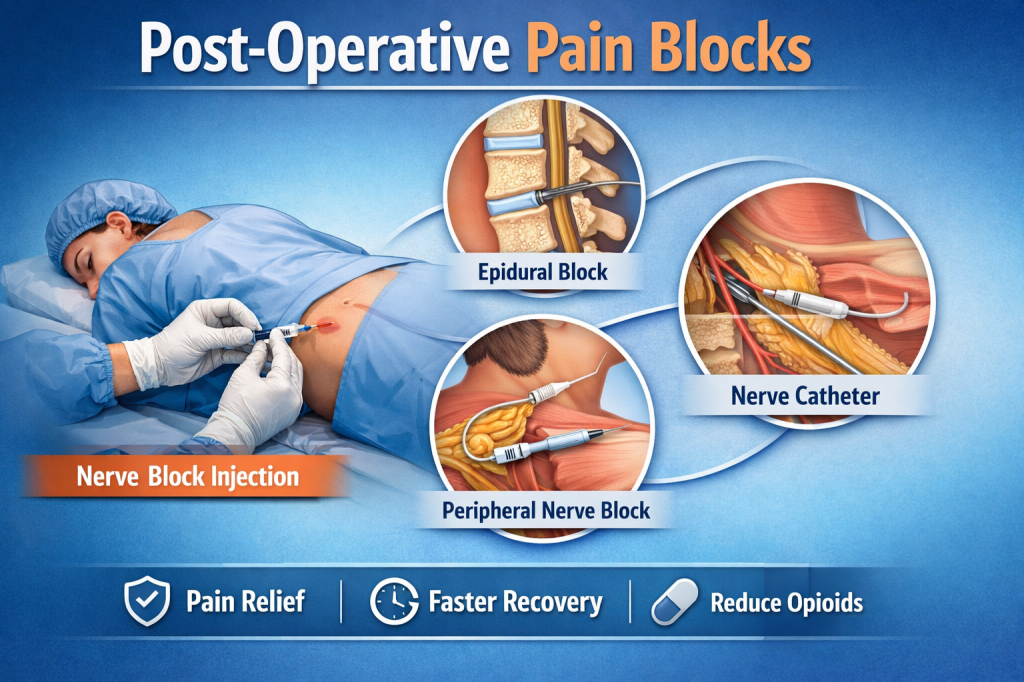
Post-operative pain blocks continue to be an area of confusion for many coders, auditors, and providers—particularly when it comes to what is separately reportable, which CPT codes apply, and what documentation is truly required to support billing. This multi-part series is designed to break post-op pain block coding down into clear, practical segments, beginning with a foundational overview of the applicable CPT codes and the documentation elements that must be present to support compliant billing. Each installment will build on the last, addressing common scenarios, compliance pitfalls, and audit-focused considerations to help ensure post-operative pain management services are coded accurately, defensibly, and consistently.
What is required in the documentation in order for the post op block to be billable?
- Who placed the block? We as coders and auditors cannot assume that the attending Anesthesiologist/CRNA for the anesthesia sedation service also performed the block. The block note documentation must clearly identify the specific provider or who placed the block.
- Who requested the block? The documentation for the block should clearly indicate that it was placed at the surgeon’s request. Phrases such as “per surgeon’s request” or “for post-operative pain management, at the request of the surgeon” are commonly used and help establish this. This language is important to support medical necessity in the event of payer questions or audits. Ultimately, the surgeon is responsible for post-operative pain management and must delegate that responsibility when appropriate.
- What type of block? Coders and auditors should identify the block type by looking for the specific name of the block performed — for example, interscalene, adductor canal, femoral, intercostal, etc.
- What delivery method was used to administer the post-operative pain procedure? The documentation must clearly indicate whether it was a single-shot injection or a continuous catheter technique. CPT selection should be based on the documented method of delivery.
- Where was the block placed? Accurate code selection depends on the anatomical location documented in the documentation Specifically, the documentation should clearly identify the nerve or region that was injected, infused, or blocked. For example, a block labeled as “Saphenous” may be reported using CPT 64447 (Femoral nerve block) if performed in the mid-thigh region (Adductor Canal), or CPT 64450 (Other peripheral nerve or branch) if performed below the knee. Additionally, the documentation must specify laterality—whether the block was performed on the left, right, or both sides—to ensure correct coding.
- Why was the block placed? Anesthesiologists must clearly document the indication for the block. When a block is performed specifically for post-operative pain and is separately billable as a fee for service, it requires distinct documentation that supports its medical necessity as a separate service. If the documentation is unclear or leaves room for interpretation regarding whether the block was part of the primary anesthetic, coders should query the clinician for clarification to ensure accurate coding and compliance.
- When was the block placed? The AMA (American Medical Association) has clarified that anesthesia time can be billed for the period spent placing a block, provided the block placement occurs after induction of the primary anesthetic but before emergence. If the block is placed after anesthesia start time but before induction, discontinuous anesthesia time should be applied, meaning the time spent performing the block is excluded from the total billable anesthesia time. To accurately determine if block time is billable or if discontinuous time must be applied, coder should review the following key documentation elements: Start time of the block injection/placement of catheter * Stop time of the block injection/catheter Induction time (primary anesthetic)
- Was the block performed under ultrasound guidance? In 2025, most block codes now include ultrasound guidance, but there are some (64450) that still don’t so it is important to know what type of verbiage we need in order to bill 76942. Ultrasound guidance may be separately billable when it is not included in the description of the nerve block and is adequately supported by documentation. To meet medical necessity requirements, the ultrasound image must be retained in the patient’s permanent medical record and clearly identify the patient and date of service. The documentation should include language similar to the following examples: Ultrasound guidance used to guide the needle for satisfactory placement (e.g. “Under US, needle guided and appropriately placed.” “Ultrasound guidance used for needle placement”). Ultrasound guidance used to view medication diffusion (e.g., “US used to visualize spread of anesthetic,” “Medication spread viewed under U/S”).
Below is a quick overview of different blocks and there CPT Codes. In the Post-Op Block Series, I will be covering different blocks each week.
| Description | 2026 Code |
| Brachial Plexus | 64415 |
| Brachial Plexus | 64416 |
| Axillary Nerve* | 64417 |
| Suprascapular Nerve | 64418 |
| Intercostal Nerve, Single Level | 64420 |
| Intercostal Nerve (each additional level) | 64421 |
| Ilioinguinal, iliohypogastric Nerves | 64425 |
| Pudendal Nerve | 64430 |
| Paracervical (uterine) Nerve | 64435 |
| Sciatic Nerve | 64445 |
| Sciatic Nerve | 64446 |
| Femoral Nerve | 64447 |
| Femoral Nerve | 64448 |
| Lumbar Plexus; Continuous | 64449 |
| Other Peripheral Nerve or Branch | 64450 |
| Sacroiliac Joint | 64451 |
| Genicular Nerve | 64454 |
| Paravertebral block (PVB) (paraspinous block) | 64461 |
| Paravertebral block (PVB) (paraspinous block) | 64462 |
| Paravertebral block (PVB) (paraspinous block) | 64463 |
| Thoracic Fascial Plane Block Codes*** | 64466 |
| Thoracic Fascial Plane Block Codes | 64467 |
| Thoracic Fascial Plane Block Codes | 64468 |
| Thoracic Fascial Plane Block Codes | 64469 |
| Lower Extremity Fascial Plane Blocks | 64473 |
| Lower Extremity Fascial Plane Blocks | 64474 |
| Abdominal Fascial Plane Blocks (TAP Blocks) | 64486 |
| Abdominal Fascial Plane Blocks (TAP Blocks) | 64487 |
| Abdominal Fascial Plane Blocks (TAP Blocks) | 64888 |
| Abdominal Fascial Plane Blocks (TAP Blocks) | 64889 |
| Unlisted | 64999 |
| * Axillary approaoch to Brachial Plexus is coded as 64415 (typically shoulder cases). True Axillary Blocks target the Axillary nerve and are coded 64417 (typically forearm/wrist/hand procedures). Review block note to confirm targeted nerve |
Disclaimer:
Chart Talk: Anesthesia Coding Conversations is intended for educational and informational purposes only. The content shared does not constitute legal, billing, compliance, or reimbursement advice. Coding, billing, and reimbursement decisions should be based on official sources such as CPT®, ICD-10-CM, ASA guidelines, payer policies, and individual facility policies, as well as the specific documentation in the medical record. Users are encouraged to consult authoritative resources and/or their compliance department for guidance applicable to their organization.

Leave a comment